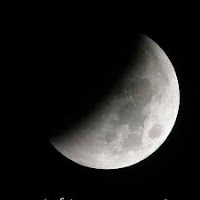
As seen from the Earth, a solar eclipse occurs when the Moon passes between the Sun and the Earth, and the Moon fully or partially covers the Sun as viewed from a location on Earth. This can only happen during a new moon, when the Sun and Moon are in conjunction as seen from Earth. At least 2, and up to 5, solar eclipses occur each year; no more than 2 can be total eclipses. Total solar eclipses are nevertheless rare at any particular location because totality exists only along a narrow path on the Earth's surface traced by the Moon's umbra.
Some people, sometimes referred to as "eclipse chasers" or "umbraphiles", will travel to remote locations to observe or witness a predicted central solar eclipse. The solar eclipse of August 11, 1999, in Europe helped to increase public awareness of the phenomenon, which apparently led to an unusually large number of journeys made specifically to witness the annular solar eclipse of October 3, 2005, and of March 29, 2006.
The last total solar eclipse was the solar eclipse of July 11, 2010; the next will be the solar eclipse of November 13, 2012. The recent solar eclipse of June 1, 2011, was a partial eclipse; the next partial eclipse will occur on July 1, 2011.
A total solar eclipse is a natural phenomenon. Nevertheless, in ancient times, and in some cultures today, solar eclipses have been attributed to supernatural causes or regarded as bad omens. A total solar eclipse can be frightening to people who are unaware of their astronomical explanation, as the Sun seems to disappear during the day and the sky darkens in a matter of minutes.
There are 4 types of solar eclipses:
A total eclipse occurs when the dark silhouette of the Moon completely obscures the intensely bright disk of the Sun, allowing the much fainter solar corona to be visible. During any one eclipse, totality only occurs at best in a narrow track on the surface of the Earth.
Some people, sometimes referred to as "eclipse chasers" or "umbraphiles", will travel to remote locations to observe or witness a predicted central solar eclipse. The solar eclipse of August 11, 1999, in Europe helped to increase public awareness of the phenomenon, which apparently led to an unusually large number of journeys made specifically to witness the annular solar eclipse of October 3, 2005, and of March 29, 2006.
The last total solar eclipse was the solar eclipse of July 11, 2010; the next will be the solar eclipse of November 13, 2012. The recent solar eclipse of June 1, 2011, was a partial eclipse; the next partial eclipse will occur on July 1, 2011.
A total solar eclipse is a natural phenomenon. Nevertheless, in ancient times, and in some cultures today, solar eclipses have been attributed to supernatural causes or regarded as bad omens. A total solar eclipse can be frightening to people who are unaware of their astronomical explanation, as the Sun seems to disappear during the day and the sky darkens in a matter of minutes.
There are 4 types of solar eclipses:
A total eclipse occurs when the dark silhouette of the Moon completely obscures the intensely bright disk of the Sun, allowing the much fainter solar corona to be visible. During any one eclipse, totality only occurs at best in a narrow track on the surface of the Earth.
An annular eclipse occurs when the Sun and Moon are exactly in line, but the apparent size of the Moon is smaller than that of the Sun. Hence the Sun appears as a very bright ring, or annulus, surrounding the outline of the Moon.
A hybrid eclipse shifts between a total and annular eclipse. At some points on the surface of the Earth it appears as a total eclipse, whereas at others it appears as annular. Hybrid eclipses are comparatively rare.
A partial eclipse occurs when the Sun and Moon are not exactly in line and the Moon only partially obscures the Sun. This phenomenon can usually be seen from a large part of the Earth outside of the track of an annular or total eclipse. However, some eclipses can only be seen as a partial eclipse, because the umbra passes above the Earth's polar regions and never intersects the Earth's surface.
The Sun's distance from the Earth is about 400 times the Moon's distance, and the Sun's diameter is about 400 times the Moon's diameter. Because these ratios are approximately the same, the Sun and the Moon as seen from Earth appear to be approximately the same size: about 0.5 degree of arc in angular measure.